
REVIEW · HEGRA AND THE ALULA TOMBS
Al-Ula: Hegra, Dadan, and Ikmah Highlights Tour
Ancient stones, modern comfort, and one big day. This six-hour AlUla outing brings together Hegra and Dadan, two of the area’s most important archaeological sites, with Elephant Rock and the Hijaz Railway station. I like the hotel pickup in an air-conditioned van, and I like the chance to see both carved tombs and inscription-covered cliffs in one outing. The main caution is that the advertised $99 price may not match the final booking total.
I also like the flexible itinerary and the included entrance fees, which make planning easier in a region where distances between sights matter. But timing can be a concern: one booking was shifted from 10:30 to 12:30, and Dadan and Ikmah were cancelled without compensation. Confirm the final price, start time, and full stop list before paying.
In This Review
- Key points to know before you go
- Why this AlUla route works well in six hours
- Hegra and the Nabataean tombs
- The Hijaz Railway station and the memory of travel
- Elephant Rock: AlUla’s simplest photo stop
- Dadan, a city shaped by caravan trade
- Jabal Ikmah, an open-air library of inscriptions
- Transport, guiding, and the shape of the day
- Is $99 a good value?
- Who should book this AlUla tour?
- My verdict: book it after checking three things
- FAQ
- Where does the tour take place?
- How long does the tour last?
- What sights are included?
- Is hotel pickup included?
- Is an English-speaking guide available?
- Are entrance fees included?
- Is the tour wheelchair accessible?
- Can the itinerary be customized?
- What are the cancellation and payment options?
Key points to know before you go
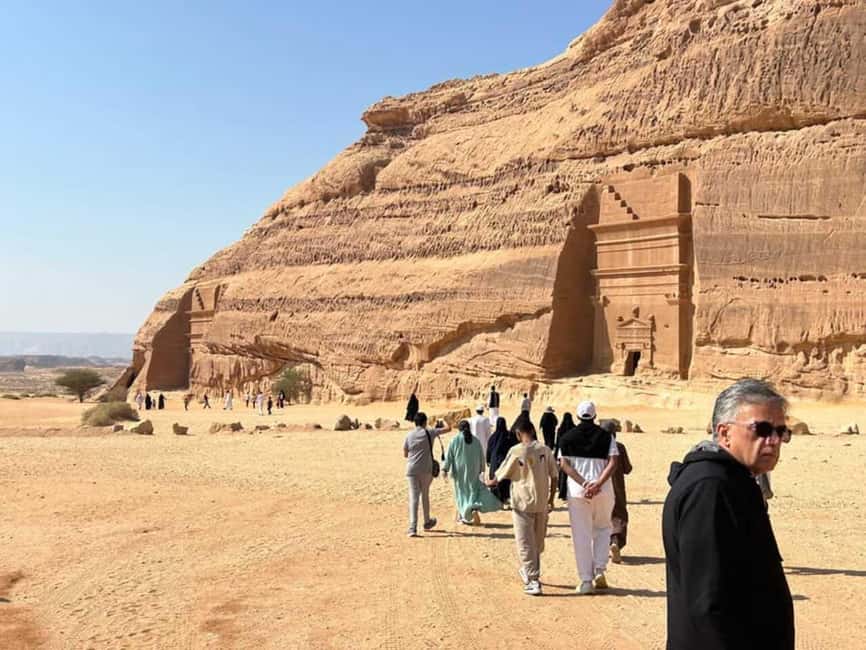
- Hegra is the headline stop: See the largest preserved Nabataean site south of Petra, including monumental tombs cut into desert rock.
- Four major sights fit into six hours: The route combines Hegra, Elephant Rock, Dadan, and Jabal Ikmah, with the Hijaz Railway station also included in the sightseeing plan.
- Hotel pickup keeps the day simple: Transfers begin at your AlUla hotel in a modern, air-conditioned van.
- Dadan and Ikmah add the human story: Dadan was a caravan way station, while Jabal Ikmah preserves inscriptions in several ancient writing systems.
- The archaeology visits use shared guiding: Hegra and the Dadan and Ikmah section are shared with a local guide and a small local group.
- Check the booking total closely: The listed $99 rate was reported as $280 per person at checkout in one case, so the final price deserves careful attention.
Why this AlUla route works well in six hours
AlUla is not a place where every major sight sits around one compact town square. The archaeological sites and rock formations are spread through a broad desert setting, so a guided vehicle saves you from sorting out transport between stops.
This tour is built for a first look. In six hours, you get the famous name, Hegra, a striking natural formation at Elephant Rock, the ancient city of Dadan, the inscription site at Jabal Ikmah, and the Hijaz Railway station. That is a lot of ground, but it gives you a useful sense of how AlUla connects nature, trade, writing, and empire.
I would not view the itinerary as a slow archaeological study. You are moving between several places, and the quality of the day depends on the schedule and how much time each stop receives. If your goal is to see the major highlights in one manageable outing, the pace makes sense. If you want extended photography or long quiet periods at each site, you may find six hours tight.
The tour includes a tour leader or driver, entrance fees, service charges, and taxes. Those inclusions help you judge the value more fairly, since the headline price is not being padded by a list of basic add-ons. Still, the final checkout price matters more than the initial display.
More Hegra and AlUla heritage trips:
- Visiting The Incredible Heritage Site Hegra in AlUla
★ 4.6 · 93 reviews - Hegra Al Ula: Sunrise Hot Air Balloon Flight
★ 4.6 · 43 reviews - Al Ula: Dadan and Jabal Ikmah Tombs Guided Tour
★ 4.2 · 26 reviews
Hegra and the Nabataean tombs
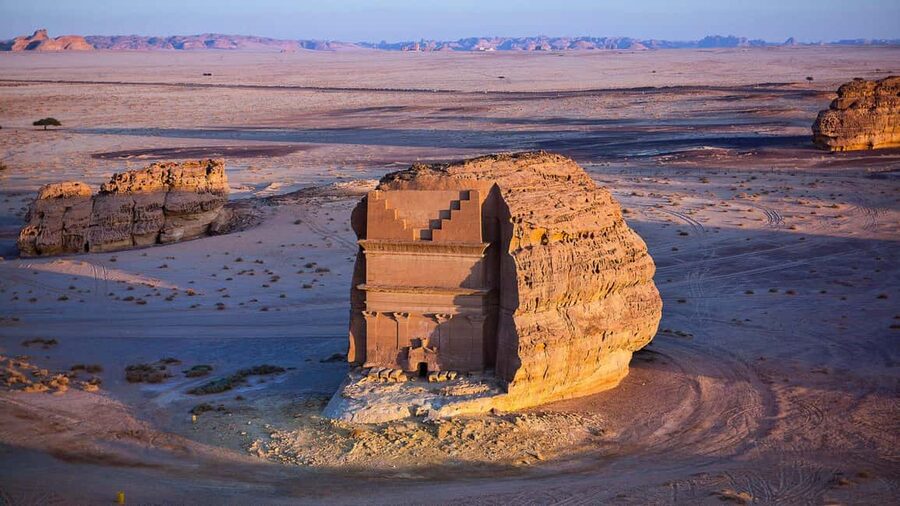
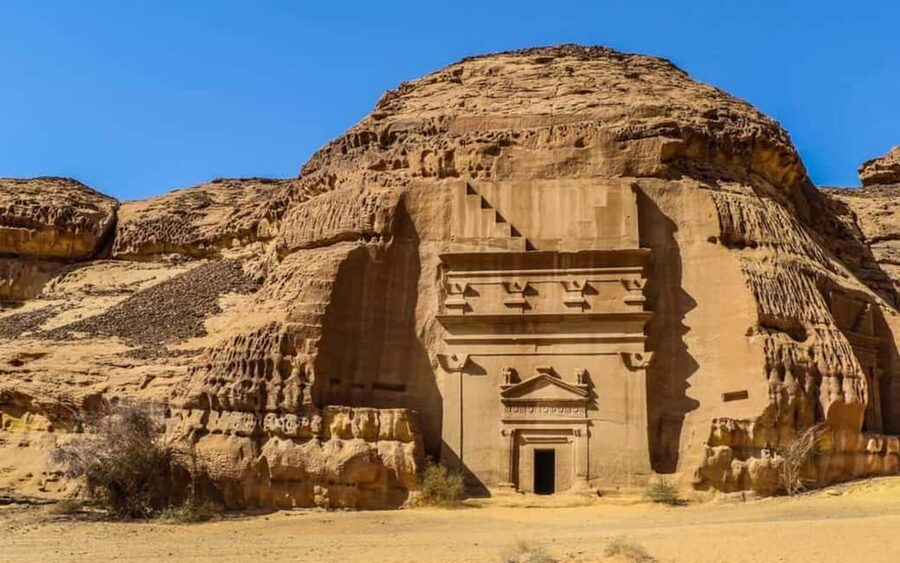
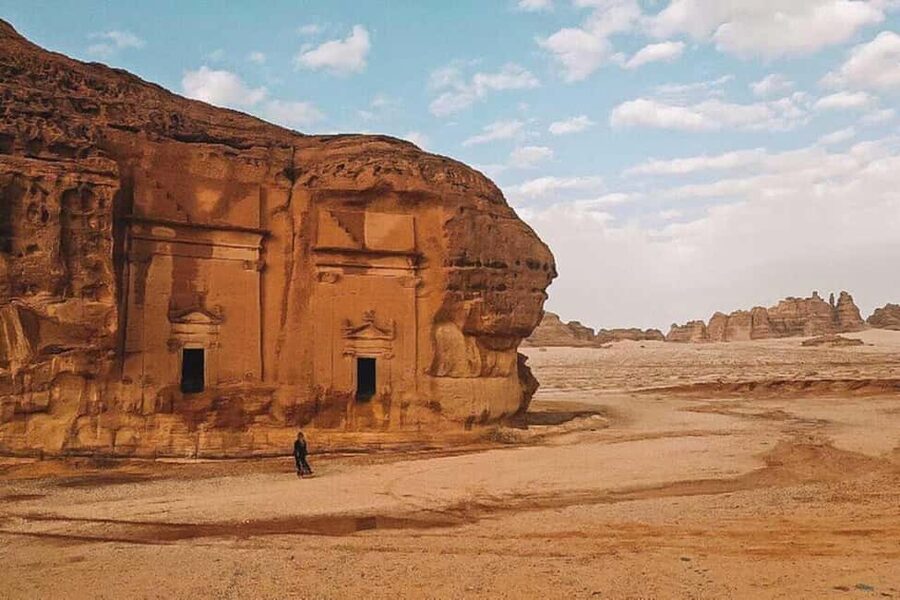
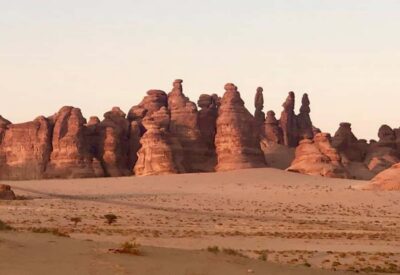
Hegra, also called Madain Saleh or Al-Hijr, is the central reason to choose this outing. It was the southernmost and largest settlement of the Nabataean kingdom after Petra, the kingdom’s capital in present-day Jordan.
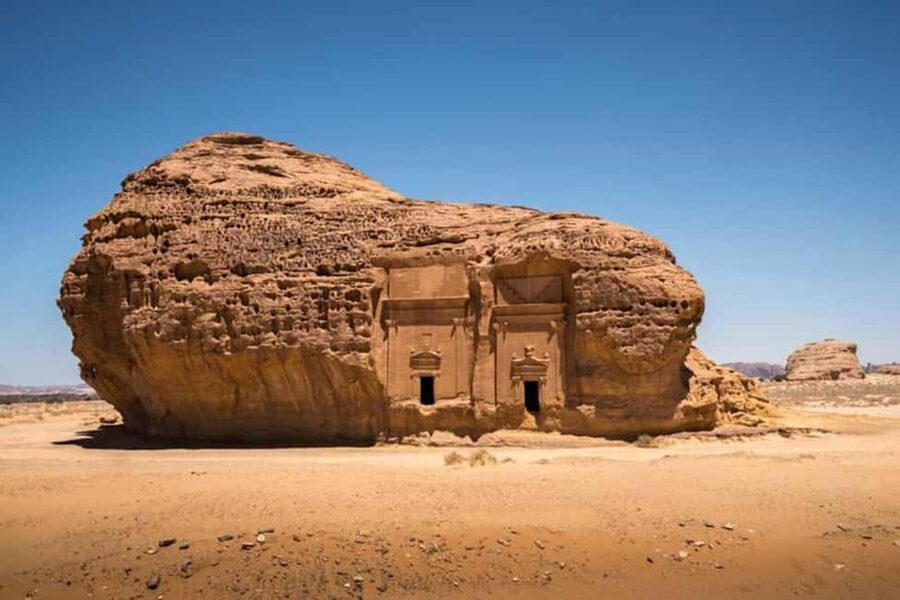
The site is best known for its monumental tombs carved into sandstone. These are not just isolated rock faces. Together, they show the scale of a major settlement linked to long-distance trade and the Nabataean world.
Hegra also carries special status in Saudi Arabia. It was the country’s first property to be inscribed as a UNESCO World Heritage site. That distinction gives the visit added weight, but the real appeal is visual: carefully cut façades appear against open desert rock, and the contrast between straight architectural lines and weathered stone is hard to miss.
Expect this part of the outing to be shared with a local guide and a small local group. That arrangement can work well because you receive interpretation on site without paying for a fully private tour. It also means you will not control every pause or every photo stop.
Give Hegra your full attention. It is easy to treat a carved tomb as a quick picture stop, then move on. Instead, look at the details in the façade and notice how the builders used the natural rock. The setting helps you understand why Hegra feels different from a conventional ruin. Much of the architecture remains attached to the stone from which it was cut.
If Hegra is your main reason for coming to AlUla, ask in advance how much time is assigned to it. The tour includes several other places, so knowing the schedule helps you decide if this format suits you.
The Hijaz Railway station and the memory of travel
The Hijaz Railway station adds a different layer to the day. Hegra takes you back to the Nabataean period, while the railway points to a much later chapter in the region’s story.
The station is included among the sightseeing stops, but the supplied information does not specify how long you remain there or the exact condition of the buildings. Think of it as a historical pause within a larger route rather than a full railway museum visit.
This stop matters because AlUla was not simply a place people reached by accident. Its location connected routes through the Hejaz, and the railway became part of the modern story of movement across the region. Your guide can help place the station alongside the older caravan routes and settlements.
I would keep your expectations measured here. The tour gives you a chance to see the station, but Hegra, Dadan, and Ikmah are the stronger archaeological anchors. If rail history is your main interest, you may want to ask whether the station receives a substantial visit or a shorter photo stop.
Elephant Rock: AlUla’s simplest photo stop
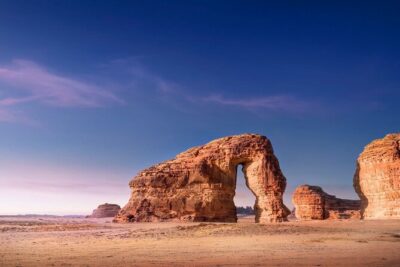
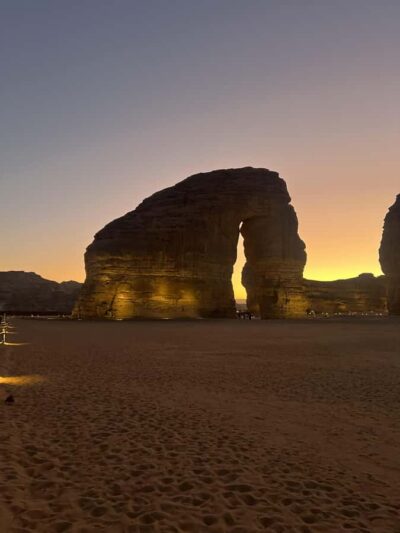
Elephant Rock is the most instantly readable sight on the route. A natural rock formation resembles an elephant, with its trunk reaching down to the ground. You do not need a long explanation to understand its appeal.
The formation is one of AlUla’s best-known landmarks and a useful change of pace after archaeological sites. Instead of looking at carved surfaces and inscriptions, you are looking at erosion and natural form. The shape is clear enough that the nickname does the work.
This stop is likely to suit almost everyone, including visitors who are less interested in ancient writing or dynastic history. It gives you a memorable image of AlUla’s sandstone scenery and breaks up the archaeology-heavy parts of the outing.
The trade-off is that Elephant Rock is a single main formation, not a large archaeological complex. The information provided does not specify activities, walking distances, or how long the stop lasts. Treat it as a focused scenic visit rather than a major half-day attraction.
For photography, the broad form matters more than small details. Look at the gap beneath the trunk and the way the rock’s shape separates from the surrounding stone. If your driver offers flexibility, this is one place where a short pause can still be worthwhile.
More things to do in AlUla:
- AlUla: Discover AlUla Like a Local Guided Tour
★ 5.0 · 25 reviews - From AlUla: Hegra Tour
★ 3.9 · 25 reviews - Al-Ula: Old Town, Hegra, and Elephant Rock Day Tour
★ 4.9 · 14 reviews - Fancy Tour of Hegra in a Vintage Land Rover
★ 4.8 · 11 reviews
Dadan, a city shaped by caravan trade
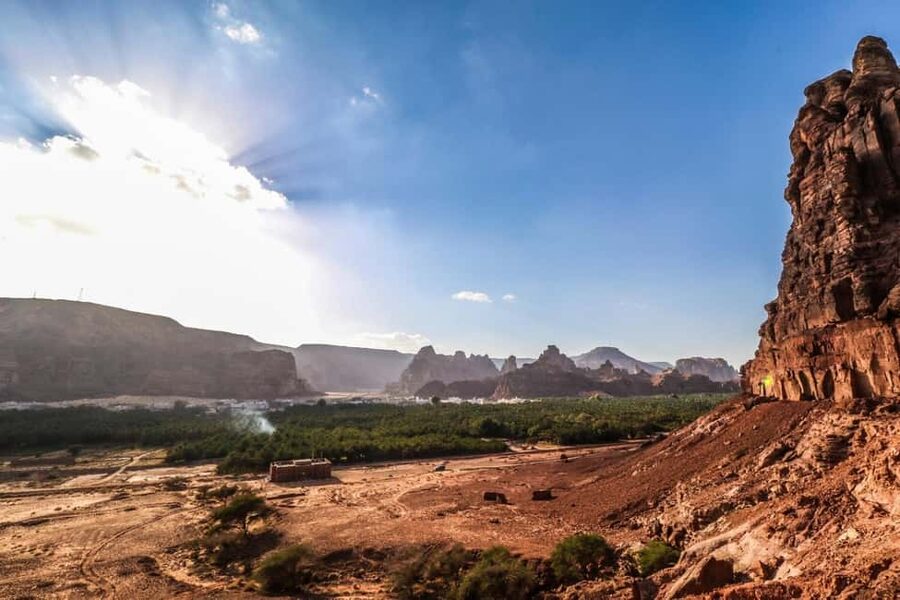
Dadan helps explain why AlUla became a meeting point for different peoples. It functioned as a caravan way station, so its importance came from movement, exchange, and location as much as from its buildings.
That context makes Dadan a useful companion to Hegra. At Hegra, you see the polished monumental side of the Nabataean world. At Dadan, you get a broader sense of the older settlements and trade networks that made the valley important.
The site is also tied directly to Jabal Ikmah. People passing through Dadan visited Ikmah to leave inscriptions and offerings, creating a record of journeys, beliefs, and public memory. In other words, the two stops make more sense together than apart.
The exact remains and visitor route are not detailed in the supplied information, so I would avoid expecting a single dramatic structure comparable to Hegra’s tomb façades. Dadan’s value lies in the story of the place and its connection to the wider valley.
This is also the stop most vulnerable to schedule changes. One booking had Dadan and Ikmah cancelled without compensation. That is a serious concern because these sites are not minor extras. If they matter to you, confirm before departure that both are operating on your date.
Jabal Ikmah, an open-air library of inscriptions
Jabal Ikmah is the most distinctive stop for anyone interested in language and ancient records. The site contains a high concentration of inscriptions and carvings in Aramaic, Dadanitic, Thamudic, Minaic, and Nabataean.
That variety is the point. You are not looking at one writing system from one period. The markings reflect the many communities and eras connected with AlUla. The site is often described as an open-air library, a fitting phrase for a remote canyon where the rock faces preserve written traces instead of shelves and books.
The inscriptions are thought to reach back as far as the first millennium BCE. Jabal Ikmah also relates to the study of Arabic because AlUla contains thousands of pre-Arabic inscriptions across several locations. Nearby sites add further evidence, including more than 450 early Arabic inscriptions at AlAqra’a and an early Islamic inscription at Naqsh Zuhayr dated to 24 AH, or 644 CE.
You do not need to read the scripts to appreciate the place. The important detail is that people stopped here, carved messages or records into stone, and left evidence of their presence for later generations. Ask your English-speaking guide to explain what can be identified and what remains uncertain.
This is where a good guide makes a real difference. Abdullah, the guide named in one booking, was praised for being kind and patient. Those qualities matter at an inscription site, where the meaning is not always obvious at first glance and a rushed explanation can turn the stop into a walk past dark marks on a wall.
The shared small-group format is a reasonable compromise. You may not get a private lecture, but you have a guide to place the inscriptions in context. Just confirm that Jabal Ikmah is included on the day you book.
Transport, guiding, and the shape of the day
Pickup is included from your hotel in AlUla, with transfers in a modern air-conditioned van. In a hot desert region, that is more than a comfort detail. It keeps the day practical and removes the need to arrange separate rides between widely spaced sights.
The tour is offered with an English-speaking live guide. The role may be shared between the tour leader and local site guides, especially at Hegra and at Dadan and Ikmah. Ask who will guide each section if detailed interpretation is important to you.
The itinerary can be customized to your preferences, according to the supplied details. That sounds useful, but you should treat it as a point to clarify rather than a promise that every stop can be rearranged freely. The route includes several named sights, and a six-hour schedule leaves only limited room for major changes.
One booking had a start time moved from 10:30 to 12:30 at short notice. A later start can affect the feel of a desert sightseeing day, particularly if you planned around meals, light, or another reservation. Confirm the departure time shortly before the outing and keep your wider schedule flexible.
Is $99 a good value?
At $99 per person, the tour looks attractive for a six-hour outing that includes hotel transfers, a driver or tour leader, entrance fees, taxes, and service charges. You are paying for convenience as well as sightseeing. The van, route planning, and access to several major sites can be valuable in AlUla.
The concern is the reported price difference. One booking began at a displayed $99 but reached $280 per person at the time of purchase. That is not a small adjustment. Do not rely on the first number you see. Check the final total, currency, group conditions, and included stops before confirming.
At the higher figure, the value becomes much harder to judge, especially if Dadan and Ikmah are later cancelled. At the lower figure, the tour can make sense for a first visit, provided the full route operates and the schedule suits you.
The free cancellation period of up to 24 hours gives you some protection if your plans change. You can also reserve now and pay later, which helps if you are still arranging your AlUla schedule. These policies do not solve a price or itinerary change, but they make the booking less rigid.
Who should book this AlUla tour?
I would recommend this tour to you if you have one day, want the major AlUla sights, and prefer a vehicle with a guide instead of arranging each transfer yourself. It suits first-time visitors who want Hegra but also want to see the valley’s natural and inscription sites.
It is particularly good for people who enjoy variety. In one outing, you move from Nabataean tombs to a railway station, from a natural rock shaped like an elephant to a city linked to caravan trade, and then to ancient writing carved into stone.
You may want a different arrangement if Hegra deserves a full, unhurried visit for you. A private tour could offer more control, but no private option is specified here, so ask directly about available upgrades rather than assuming one exists.
I would also hesitate if your schedule cannot absorb a last-minute time change. The reported move from 10:30 to 12:30 shows why you should avoid placing an important evening reservation too close to the tour.
My verdict: book it after checking three things
This is a strong highlights tour on paper, and the route covers the best-known cultural and scenic names around AlUla. I especially like the combination of Hegra’s monumental tombs and Jabal Ikmah’s personal inscriptions. Together, they show both the public power and everyday movement of ancient communities.
Before booking, confirm the final price, the departure time, and that Hegra, Dadan, and Ikmah are all operating. If those three details are clear, the included transport, entrance fees, and English-language guiding make this a practical way to see a lot in six hours.
If the price jumps sharply or Dadan and Ikmah are unavailable, I would compare other options before paying. The tour is worth considering, but its value depends on receiving the full route at the price you were shown.
FAQ
Where does the tour take place?
The tour takes place in and around AlUla in Saudi Arabia’s Al Madinah Province.
How long does the tour last?
The stated duration is six hours.
What sights are included?
The sightseeing plan includes Hegra, the Hijaz Railway station, Elephant Rock, Dadan, and Jabal Ikmah.
Is hotel pickup included?
Yes. Pickup is included from your hotel in AlUla, with transfers in a modern air-conditioned van.
Is an English-speaking guide available?
Yes. The activity includes a live English-speaking tour guide.
Are entrance fees included?
Yes. Entrance fees, service charges, and taxes are included in the stated inclusions.
Is the tour wheelchair accessible?
Yes. The activity is listed as wheelchair accessible.
Can the itinerary be customized?
The tour includes flexibility to customize the itinerary according to your preferences. Because the outing lasts six hours and includes several sites, confirm the available changes before departure.
What are the cancellation and payment options?
You can cancel up to 24 hours in advance for a full refund. You can also reserve now and pay later.
Just added in Al Ula
- Private Abseiling in Alula Desert.★ 5.0 · 2 reviews
- AlUla: Private Zipline Experience★ 5.0 · 1 review
- AlUla: Sharaan Platinum Dinner Safari★ 5.0 · 2 reviews
- Al-Ula: Guided Horse Riding★ 5.0 · 3 reviews
- AlUla: Sharaan Nature Reserve★ 5.0 · 4 reviews
- Al-Ula: Dadan & Jabal Ikmah Tour with Optional Pickup★ 3.8 · 4 reviews
- Oasis Adventure in Alula★ 4.2 · 6 reviews
- Fancy Tour of Hegra in a Vintage Land Rover★ 4.8 · 11 reviews
Hegra and the AlUla Tombs, compared.
Visiting The Incredible Heritage Site Hegra in AlUla
Read our review →
Al-Ula: Old Town, Hegra, and Elephant Rock Day Tour
Read our review →
Hegra Tour: AlUla’s No.1 Haven For Nature, Wildlife Lovers
Read our review →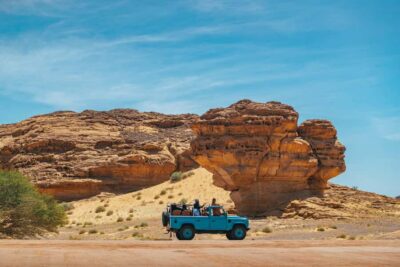
Visiting the Incredible Heritage Site Hegra in AlUla.
Read our review →Browse the lists this tour appears in